Myanmar travel advisory (2026): Following the February 2021 military coup, most Western governments advise against all travel to Myanmar. The situation in Bagan has changed significantly since this post was written in 2019. Check your government’s travel advisory before making any plans. Read our guide to travelling Myanmar responsibly.
A local stopped us on his bike while we were driving between temples. We’d been asking around all morning — at the hotel, at the guesthouses, at a tea shop — and everyone had said the same thing: no temples left to climb. The ban was new, the signs were up, the stairs were fenced off. But this man on his bike said he knew a few that were still open. He offered to show us.
We followed him on dusty paths through scrubland, past temples we hadn’t noticed, and arrived at a place that turned out to be almost hidden in plain sight — close to the busy roads, but invisible unless you knew where to look. That was October 2018.
A lot has changed since then. If you’re looking for temples to climb in Bagan in 2026, the answer is no — the ban is complete. But the story of how it happened, the GPS coordinates from our visit, and the legal alternatives for getting the sunrise view are worth knowing. That’s what this post covers.
The short answer: temple climbing in Bagan is now completely banned.
Key Takeaways
- Temple climbing in Bagan is now completely banned — all stairs are fenced and enforcement has tightened since UNESCO World Heritage designation in July 2019
- The GPS coordinates in this post are from October 2018. Access to these temples may no longer be possible
- The best legal alternatives for sunrise/sunset views: Nan Myint Tower viewing terrace and hot air balloon flights
- Western governments currently advise against all travel to Myanmar — check your government’s advisory before planning a trip
- Bagan has more than 3,500 temples and pagodas — the ground-level experience alone is extraordinary
Why climbing temples in Bagan was banned
The temples of Bagan were built between the 9th and 13th centuries. Most are made from fired brick — impressive in their age, but fragile under the weight of thousands of tourists walking on their upper terraces every year.
Three things accelerated the ban:
The 2016 earthquake. A 6.8 magnitude earthquake struck the Bagan area in August 2016, damaging more than 400 temples and weakening the structural integrity of many more. The Guardian reported at the time that some temples were at immediate risk of collapse. Climbing them after the earthquake was considered reckless by conservationists.
The 2017 tourist death. An American tourist died after falling from a temple in 2017. The incident prompted the government to act — safety could not be ignored. The general ban on climbing was put in place shortly after.
UNESCO World Heritage designation. In July 2019, Bagan was inscribed on the UNESCO World Heritage List at the 43rd session of the World Heritage Committee in Baku. One of the conditions of World Heritage status is the protection of the site’s integrity — which included formally ending tourist access to the upper terraces. Since July 2019, enforcement has been significantly stricter.
There was also the issue of erosion. The soft brick and stucco surfaces of the temples are damaged by every footstep. Ancient murals inside the temple chambers were being destroyed by moisture from climbers’ breath. The conservation argument was strong even before the safety issues arose. And for many locals, the temples are active places of worship — being climbed by tourists in flip-flops was not a welcome development.
The GPS coordinates: our October 2018 visit
In October 2018, before the UNESCO designation and before enforcement tightened further following the 2021 coup, we found two temples that were still accessible to climb. We’re keeping the coordinates here as a historical record — but we want to be honest: we cannot confirm these temples are accessible today, and there are good reasons not to try to climb them even if they were.
The first temple our guide showed us:
Location: 21.176919, 94.881472
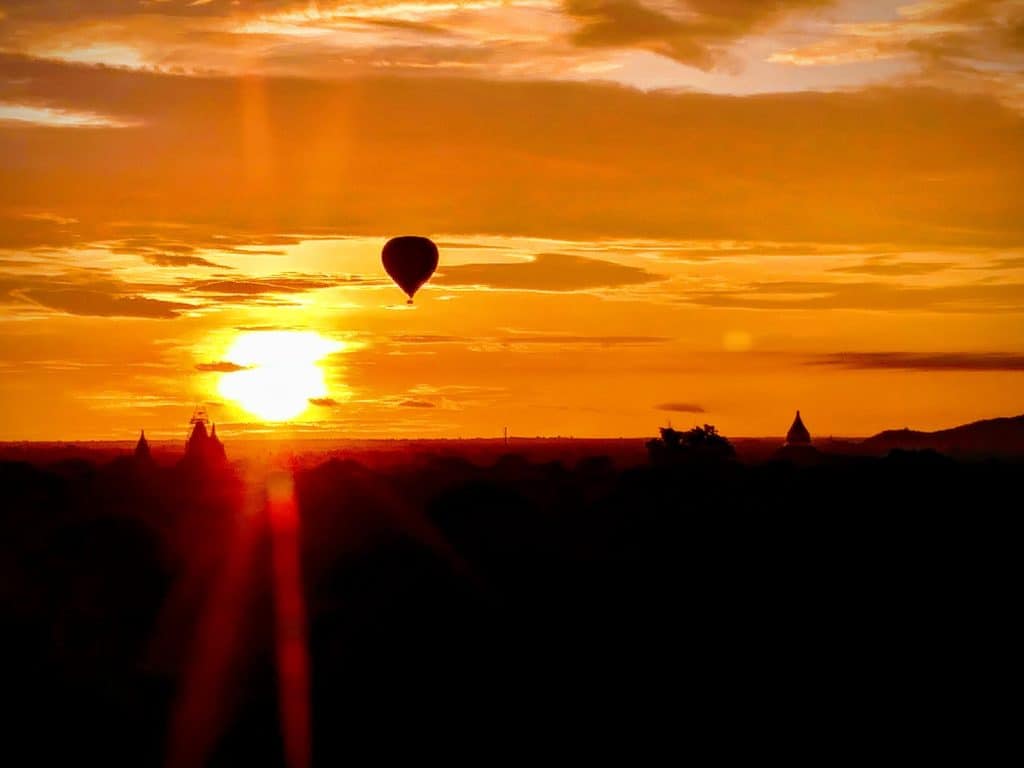
The climb was steep and not easy. The views were extraordinary — looking out over a plain of thousands of temples and pagodas in every direction, with hot air balloons drifting across the horizon at dawn. Nobody else was up there when we arrived.
The second, which we found independently on the way back:
Location: 21.150000, 94.861250
Easier to climb — there were platforms you could stand on. We spotted people on the upper terrace from the road, went to find it, and there were only a handful of other tourists there. Better for sitting; the view from the first was more impressive.
Additional locations from our research at the time (we did not visit these personally):
- Temple at 21.14805, 94.871902 — stairs were accessible
- Temple near She Myet Hna, 21.169197, 94.857 — views interrupted by road and town
- Temple at 21.156784, 94.867959 — directly below the balloon flight path, good for sunrises
- Temple at 21.178849, 94.872101
- Temple at 21.159125, 94.860988 — marked as “Accessible roof” in mapping data we had at the time
- Temple at 21.16147, 94.867761 — reportedly good for both sunrise and sunset
- Temple at 21.145187, 94.8817 — more accessible, stairs present
These are October 2018 coordinates. Please do not use them to climb a closed or forbidden pagoda — both for your own safety and out of respect for the temples and the people who consider them sacred.
Can you still climb temples in Bagan? The 2026 situation
The short answer is: no. The ban is complete. Since 2019, all temples in the Bagan Archaeological Zone have had their upper terraces closed to tourists. Stairs are fenced off, and signs are posted throughout the site. Since the 2021 military coup, government enforcement of restrictions on the archaeological zone has become stricter, not more relaxed.
Some recent travellers (2024–2025) report that local fixers will offer to show you a way up for a fee. Whether this is worth doing is a question of personal ethics and risk tolerance — the temples are genuinely not safe to climb in many places post-earthquake, and contributing money to this kind of arrangement undermines the conservation effort. We can’t recommend it.
The Bagan experience is not diminished by the ban. Walking between 3,500 temples at ground level, watching sunrise from an open field, cycling through the plain at dusk — none of this requires being on top of a temple.
Where to watch sunrise and sunset over Bagan legally
Nan Myint Tower viewing terrace
The government’s designated alternative to temple climbing is the Nan Myint Tower at the Bagan Viewing Tower complex, which has an observation deck with panoramic views over the archaeological plain. It is the officially sanctioned spot for watching sunrise and sunset over the temples. It costs a small entrance fee and is a short drive from most accommodation in Nyaung-U.
It’s not the same as being on a temple rooftop — you’re watching through a railed deck rather than sitting on warm sandstone 2,000 years old. But the views are genuine and the access is legal.
Hot air balloon over Bagan
This is the best way to see the plain. Hot air balloon flights over Bagan at sunrise are one of the most iconic travel experiences in Southeast Asia — the image of hundreds of temples emerging from the morning mist below is simply spectacular. Balloon flights over Bagan run during the dry season (October–March) and need to be booked in advance. Availability depends on wind and visibility, and operators have paused services since the 2021 coup — check current status when planning.
Open field at ground level
The simplest option: hire an e-bike or horse cart at dawn, drive to an open area of the plain away from the main roads, and watch the sunrise from the ground. There are spots across Bagan where you can sit on the steps of a small, less-visited pagoda (at ground level only) and watch the sky light up over the plain without breaking any rules.
Temple etiquette in Bagan
Whether or not you’re trying to climb, the Bagan temples are active religious sites. A few things to know:
- Remove shoes and socks before entering any temple — no exceptions
- Dress modestly: shoulders and knees covered
- Do not touch murals or carvings inside the chambers
- Flash photography inside the temples accelerates pigment deterioration — use natural light or turn off flash
- Many of the outer structures have seated Buddha images — these should be treated with the same respect as a working shrine
For more background on why monks wear orange robes and the significance of the religious sites you’re visiting, see the guide on why monks wear orange robes — it gives helpful context for visiting any Buddhist sacred site in Myanmar.
When to visit Bagan
Bagan’s dry season runs November through February. This is when the skies are clear, the heat is manageable, and hot air balloon flights operate reliably. Sunrise over the plain is spectacular year-round, but the clearest skies and coolest mornings are in February, when temperatures are comfortable and the balloon operators are at full capacity.
The monsoon season (May–October) brings dust storms, heavy rain, and grounded balloons. The landscape can be atmospheric in a different way — fewer tourists, greener vegetation — but it’s not the classic Bagan experience.
Also read the guide to New Bagan vs Old Bagan for context on the different areas of the archaeological zone and where to base yourself.
Tours and activities in Bagan
The selection below shows tours and experiences available in Bagan — subject to current operator availability:
Frequently asked questions about Bagan temple climbing
Can you climb temples in Bagan?
No. Climbing temples in Bagan has been completely banned since 2018–2019, with enforcement significantly tightening after UNESCO World Heritage designation in July 2019. All upper terraces are fenced off. The legal alternative for panoramic views is the Nan Myint Tower viewing terrace or a hot air balloon flight at sunrise.
Why was temple climbing banned in Bagan?
Three main reasons: a 6.8 magnitude earthquake in 2016 weakened temple structures, making climbing dangerous; an American tourist died after falling from a temple in 2017; and widespread tourist climbing was accelerating erosion of the 9th–13th century brickwork and destroying ancient murals. UNESCO World Heritage designation in July 2019 formalised the ban.
Where is the best place to watch sunset in Bagan?
The Nan Myint Tower viewing terrace (government-approved, paid entry) offers panoramic views over the plain. For the best experience, a hot air balloon flight at sunrise — when conditions allow — is unrivalled. At ground level, cycling to a quiet area of the archaeological zone at dusk and watching from the base of a less-visited pagoda is simple and free.
Is it safe to visit Bagan in 2026?
Most Western governments currently advise against all travel to Myanmar following the February 2021 military coup and ongoing conflict. Bagan itself is in the Mandalay Region, which has had varying levels of security. Check your government’s travel advisory and monitor developments carefully. Some travellers continue to visit; conditions change frequently.
How many temples are in Bagan?
Bagan has more than 3,500 temples, pagodas, and religious monuments — the result of an extraordinary building programme between the 9th and 13th centuries, when the Pagan Kingdom controlled much of present-day Myanmar. The archaeological zone covers an area of roughly 67 km². The sheer density of temples across the plain is what makes the Bagan sunrise and sunset so remarkable, even from ground level.